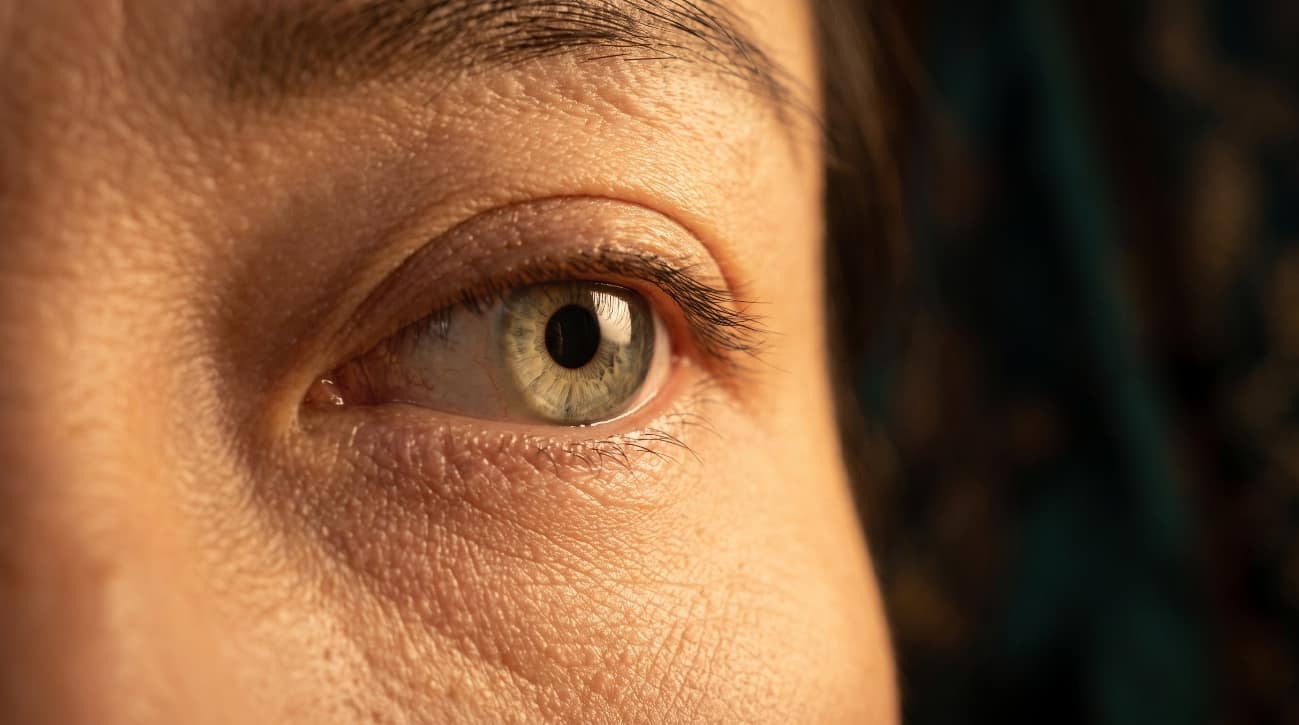
The eyes and the mirror of Shen
Get to know the Mian Xiang traditions regarding Sanpaku, the willpower stamped between the eyebrows, the architecture of the gaze, and what the brightness of the eyes symbolizes about vitality.
Vulnerability, willpower, and bone heritage
The white below the iris, the line between the eyebrows, and the bones of the face
In Mian Xiang, when the white sclera clearly appears below the iris at rest—the so-called Lower Sanpaku—the tradition associates this trait with a state of constitutional vulnerability, as if the defense against the environment were exhausted. In the space between the eyebrows, a solitary, deep vertical crevice is called the Suspended Needle: symbolically, it is associated with an incorruptible willpower that, according to tradition, would take a toll on the tenderness of relationships.
A depression at the root of the nose, the Shan Gen, is read as constitutional sensitivity linked to the age of 41. High cheekbones well-covered with flesh—the Dragon Knolls—are traditionally read as prestige and the magnetism of command. And a central cleft in the chin is associated with the archetype of one who seeks constant recognition and applause, never satisfied with an entirely discreet life.
Strategy, heritage, and repressed fire
The hooked nose, the parents' forehead, and the signs of a fiery temperament
The nose with a convex bridge and downward-curved tip—the hooked nose—is traditionally associated with a strategic sense for negotiations, though in excess, it can suggest distrust and coldness. The upper corners of the forehead, called the Parents' Palace, are read symbolically as a record of the relationship with parental figures: wide and smooth suggest inherited stability; marked by depressions, they indicate the need for early emancipation.
The large, pendulous earlobe is associated, in various traditions, with generosity and lasting luck. The Upper Sanpaku, with the white visible above the iris, is read as an accumulation of repressed hostility and combative distrust. And striking asymmetry between the two eyes is traditionally interpreted as the duality between the confident public image and the insecurities lived in silence in private life.

The architecture of the gaze
Elongated slits, layered eyelids, and protruding eyes
The Phoenix Eye, with its elongated slit and slightly upward-curved outer corner, is one of the most celebrated traits in the Mian Xiang tradition, associated with innate dignity and diplomatic refinement. A visible third fold on the upper eyelid suggests, symbolically, a mind that evaluates consequences across multiple temporal horizons—strategic sophistication.
Eyes that advance beyond the orbital ridge, resembling a protruding gaze, are read as a communicative and impatient temperament, without filters. In contrast, eyes deeply set under a firm arch recall the archetype of the solitary, skeptical, and introspective thinker. And a pupil that rests slightly displaced toward the inner corner is associated, in this tradition, with constant vigilance—the signature of someone who has been betrayed and learned to map risks before trusting.
The body speaks through the eyes
Tones, drooping eyelids, and the gaze that does not blink
A sclera that loses its porcelain-white tone and acquires a yellowish hue, with visible vessels, is read in Chinese medical physiognomy as a sign of hepatic congestion linked to accumulated irritation. The subtle drooping of one of the upper eyelids, without an acute cause, is associated with a moment of disillusionment with one's own ideals—a project that collapsed or a disappointment with someone admired.
The area under the lower lashes, turgid and luminous—the so-called Wo Can—is traditionally read as a reservoir of vitality and magnetism with children. Fine, premature lines around the eyes, before the age of thirty, symbolically tell a story of forced maturity in childhood. And a fixed gaze that rarely blinks is read, in this tradition, as a sign of ideological rigidity—the mind captured by a certainty that does not engage in dialogue.
Distances, Bitterness and the Inert Dreamer
Distant eyes, close-set eyes, and the iris floating in the white
An eyelid that takes a triangular shape, with the outer corner drooping, is read in Mian Xiang as the Physiognomy of Karmic Bitterness — the resentment accumulated from giving that seemed unrewarded. Eyes set far apart suggest, symbolically, a broad and tolerant spirit, yet one less attentive to the details of the fine print. Conversely, eyes set very close together indicate, in this tradition, meticulousness and nearly obsessive focus.
A small iris, floating in a wide field of white, is associated with the archetype of the dreamer who plans to perfection but hesitates to take the first practical step. And fleshy, cushioned upper eyelids point to someone who prioritizes physical well-being and restorative rest over productive haste — provided it does not turn into inertia during moments requiring effort.

The meaning you have just read is the basis for understanding what your face reveals. Yet the exact message lives in the details only your face holds. Are the eyebrows arched or straight? Is the distance between the eyes wide or close? Is the line of the nose straight or slightly curved? Is the jaw defined or soft? In physiognomy, each of these small elements radically changes the interpretation, revealing anything from inherited personality traits to potentials still awaiting your recognition.
If you are looking for an exact answer and don't want to be left wondering what your face is asking of your practical life today, we can go deeper. Use 1 Mística Palm Credit for a Sophisticated Physiognomy Analysis. Simply send a photo of your face on our platform to receive a complete, serious diagnosis focused 100% on your current moment.
Keep exploring
Discover a symbolic and respectful facial reading of the eyes and the Shen.