Eyebrows, the Forehead and the Palaces of the Brow
Explore the tradition of sword eyebrows, the unibrow, the thread of longevity and the symbolic palaces of the forehead, including the Yin Tang and the Career Palace.
The Razor, Sweetness and the Light of the Spirit
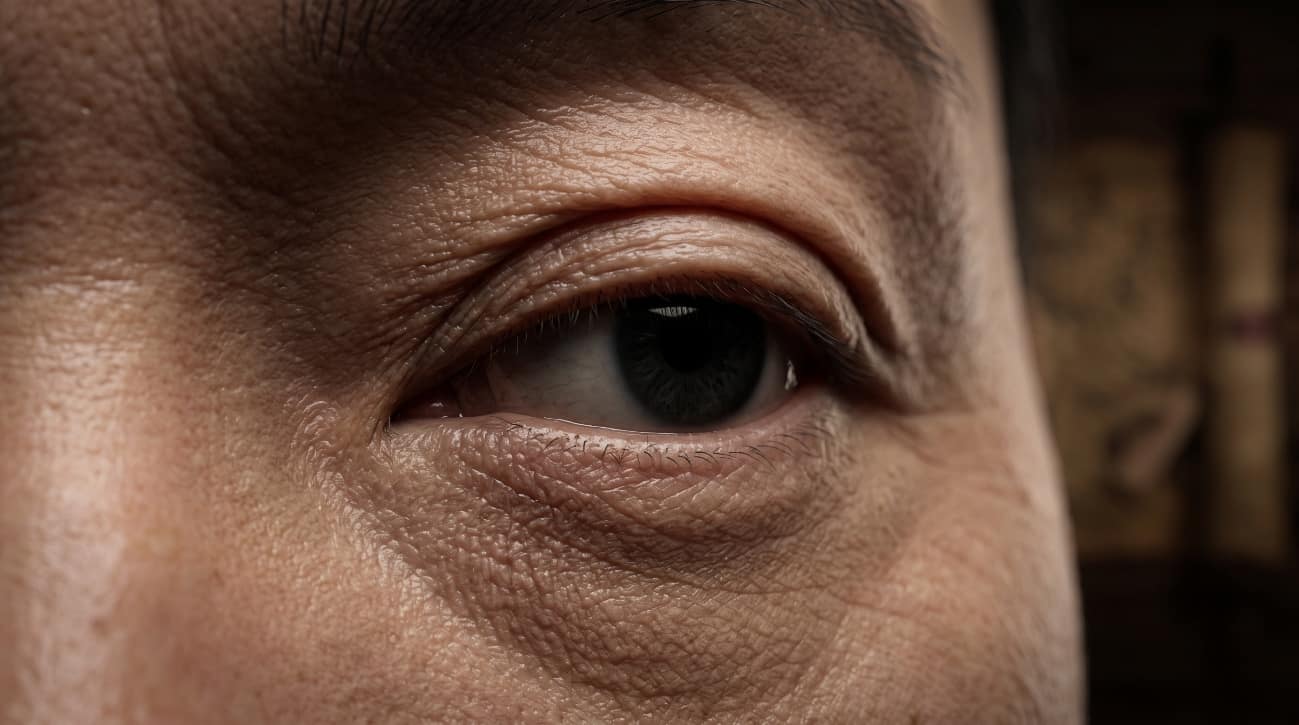
Lids without fat, sharp corners and the glow that reveals the Shen
Dry upper eyelids stretched directly over the orbit are associated, in the tradition, with a logical and cutting judgment, barely permeable to sentimentality. The inner corner of the eye, when long and sharp like a needle, is read symbolically as the mark of debaters who detect flaws in seconds.
In contrast, a soft and rounded outer corner, like a fish tail, confers a gentle look that disarms surrounding tensions. At the apex of Mian Xiang evaluation is the Shen — the inner brightness of the eyes: when strong and crystalline, it is associated with clarity of purpose and spiritual alignment; when dull and opaque, it is read as an alarm for burnout and an urgent need for rest and reconnection with nature.
The Language of the Eyebrows
Blades, sparse strands, the unibrow and the seagull wing
Straight and thick eyebrows that rise like blades — the Sword Eyebrows — are traditionally associated with an inflamed sense of justice and the courage to face corrupt superiors. Thin and sparse strands suggest, in this tradition, the need to build support networks without relying so heavily on blood ties. When the hairs of both eyebrows meet in the center, forming a unibrow, the symbolic reading points to a mind that ruminates on past grievances and struggles to forgive.
In contrast, the Seagull Wing Eyebrow — with a vigorous rise and elegant fall — is read as a talent for public articulation and leadership. And strands that bristle vertically at the beginning of the eyebrow, next to the nose, are associated with a temperament that reacts with immediate defensive fury to any setback.

Compassion, Longevity and the Three Heavens
Drooping tails, the sacred thread and the temples that tell of journeys
An eyebrow whose outer tip dips below the eye line is read, in this tradition, as the archetype of the Helpless Good Samaritan — generous to the extreme, even when the cause does not merit such sacrifice. A single, long, lonely strand that grows after age forty is revered as the Shou Thread, a symbolic sign of longevity and late-life lucidity, which should never be plucked out of vanity.
Sunken temples are traditionally associated with trials in strange lands — denied visas, culture shocks — while broad and luminous temples refer to the citizen of the world, who flourishes in international networks. And three continuous horizontal lines on the forehead, without interruptions, compose the harmony of the Three Waves — Heaven, Man, and Earth — associated with spiritual, social, and material wisdom in balance.
The Forehead as a Map of Youth
Scars on the forehead, the widow's peak and the bones of courage
A scar that cuts through one of the horizontal lines of the forehead is read as the mark of a severe pause in the professional ascent curve, requiring the construction of new channels of resilience. The hairline that advances in a triangle over the center of the forehead — the Widow's Peak — is associated with romantic magnetism and an early break with family traditions.
A round and full forehead refers to pedagogical imagination and a fertile visual memory, while a straight and angular forehead is read as the mind that structures facts, oriented toward logic and organization. And a robust bony ridge over the eyebrows — the Dragon Bone — is traditionally associated with physical audacity and lucidity in the face of extreme crises.

The Career Palace and the Warnings of the Skin
Receding foreheads, greasy shine and the signs of the Yin Tang
A short forehead that slopes backward is read as kinetic intelligence — learning by doing, rather than ruminating on theories. A constant greasy shine on the forehead is associated, in Taoist physiognomy, with a saturation of daily worries, calling for detoxification and walks in the open air. A pigmented mark at the midpoint of the forehead — the Career Palace — is traditionally read as the symbolic duty to exercise authority with honor, avoiding arrogance.
Three vertical wrinkles in the Yin Tang, the space between the eyebrows, suggest a mind divided between family, profession, and spiritual vocation, calling for courageous choices. And a sudden redness in this same region is read as a symbolic warning of prudence in the face of imminent confrontations — the best conduct is discretion until the color returns to its natural tone.
The meaning you have just read is the basis for understanding what your face reveals. Yet the exact message lives in the details only your face holds. Are the eyebrows arched or straight? Is the distance between the eyes wide or close? Is the line of the nose straight or slightly curved? Is the jaw defined or soft? In physiognomy, each of these small elements radically changes the interpretation, revealing anything from inherited personality traits to potentials still awaiting your recognition.
If you are looking for an exact answer and don't want to be left wondering what your face is asking of your practical life today, we can go deeper. Use 1 Mística Palm Credit for a Sophisticated Physiognomy Analysis. Simply send a photo of your face on our platform to receive a complete, serious diagnosis focused 100% on your current moment.
Keep exploring
Know what the eyebrows and the forehead reveal about will and destiny.