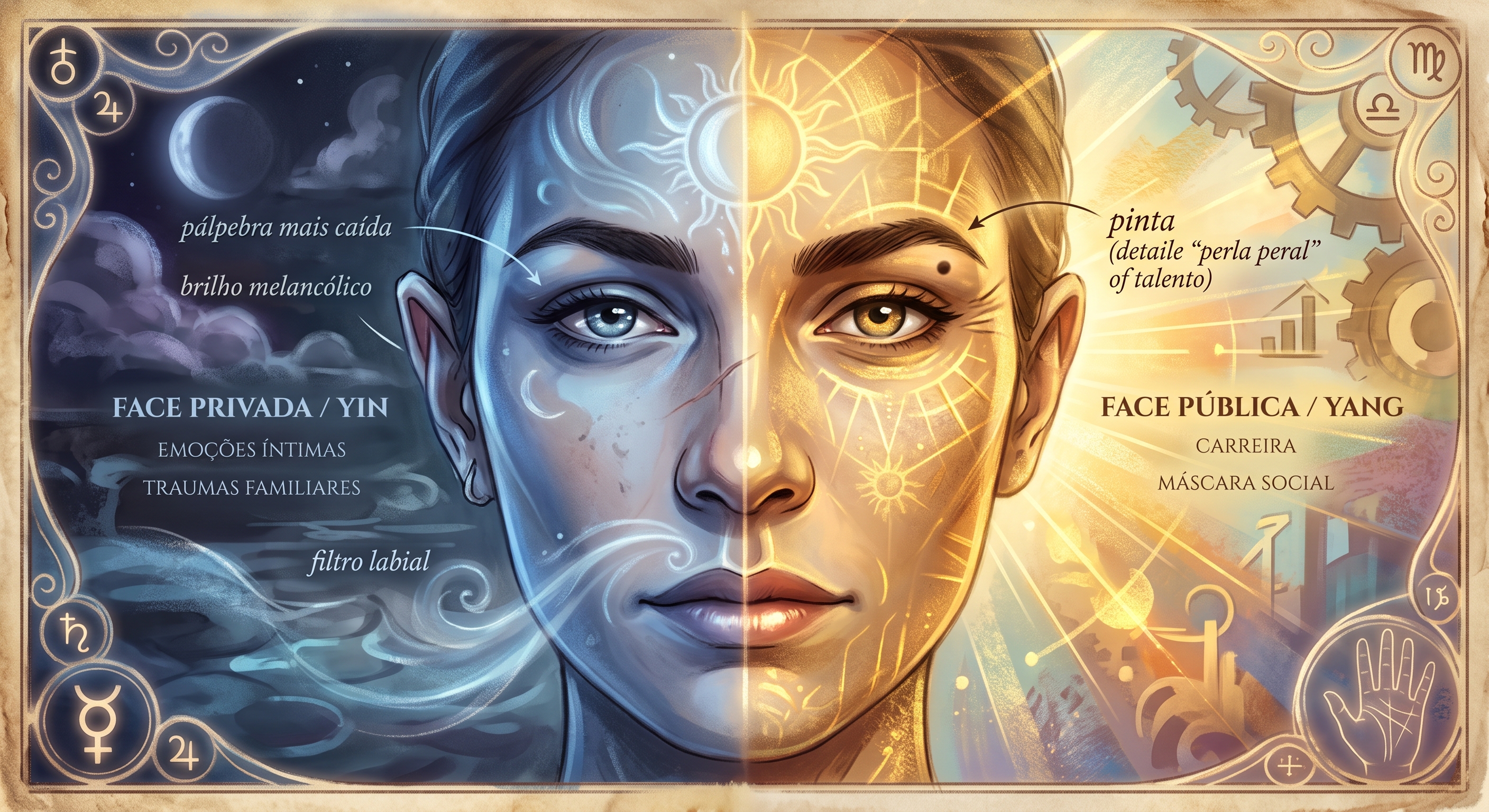
Ears, temples, and the neck as a pillar of transmission
Discover the ear as a prenatal matrix, the palace of the temples as the traveler's gaze, the ear concha and the neck as a pillar of transmission.
The ear and the prenatal matrix
The inviolable sentinels of genetic destiny
Ears are the inviolable sentinels of genetic and ancestral destiny. Unlike other facial features, which reshape themselves under the impact of daily emotions, ears preserve almost intact the geometry established during intrauterine gestation. In bodily hermeneutics, they draw the map of an inverted fetus: the lobe symbolizes the head; the outer helix, the spinal column. The consistency and detachment of the lobe operate as the primordial thermometer of karmic inheritance. Turgid, voluminous, and detached lobes grant anchorage and serene longevity, allowing a person to weather storms with unshakable calm. Attached lobes reveal the pioneering warrior: one who forges their own emotional stability in the heat of experience.
The shield of the helix and the rebel of the anti-helix form another layer of reading: when the inner cartilaginous curve (the anti-helix) visibly protrudes beyond the protective outer edge (the helix), we are faced with the incorrigible iconoclast. This configuration reveals a soul that rejects inherited canons, academic dogmas, or blind corporate orders, necessitating the reinvention of its own rules of conduct. The auricular concha—the central cavity of the ear—functions as an inner eco-temple: its depth and shape suggest a person's capacity to listen to the internal and external world. Deep conchae indicate refined receptivity and acoustic sensitivity to subtle frequencies; shallow conchae suggest greater selectivity and a focus on the practical.
The palace of the temples and the traveler's gaze
The upper lateral zone and the temple of movement
The upper lateral zone, located between the end of the eyebrows and the beginning of the hairline, is known in Eastern physiognomy as the Palace of the Temples. This region is associated with the traveler's spirit: its fullness and luminosity indicate someone who processes life through movement, exploration, and displacement. Full and radiant temples suggest adventurous vitality and the courage to cross boundaries—physical, mental, or cultural. Recessed or dull temples may indicate that the energy of movement has been redirected inward, generating contemplative richness but requiring care regarding isolation.
This zone is also observed as a thermometer for mental circulation: visible veins at the temples while at rest suggest intense cerebral activity and, in some cases, nervous tension that calls for relief. Reading the temples complements that of the interciliary space (Yin Tang): while the latter reveals mental pressure at the center, the temples show how this pressure is distributed laterally, whether it concentrates or dissipates.
The neck as a pillar of transmission
The bridge between mind and body
The neck is the transmission pillar between the head (the dwelling of the mind) and the torso (the seat of emotion and action). In esoteric physiognomy, its thickness, length, and firmness reveal how communication flows between these two centers. A robust, short neck suggests someone who processes decisions with instinctive speed, connecting mind and action without much mediation—executive strength, but a risk of impulsivity. A long, slender neck indicates someone who filters decisions through a long reflective bridge: greater analytical depth, but a risk of over-elaboration and analysis paralysis.
The Adam's apple—the projection of the larynx—is observed as a marker of the expression of the word: its prominence suggests a voice that makes itself heard, someone who does not fear occupying sound space. The nape—the back of the neck—reveals the resistance of the will: a strong and erect nape indicates unwavering determination; a tense and curved nape may indicate someone who carries excessive weight on their shoulders, literally and metaphorically. The pre-auricular furrows—the small vertical lines in front of the ear—function as a stress filter: their depth and number suggest the level of chronic tension the person processes in the nervous system. These readings, like all those in symbolic physiognomy, are invitations to reflection, not closed diagnoses.

The meaning you have just read is the basis for understanding what your face reveals. Yet the exact message lives in the details only your face holds. Are the eyebrows arched or straight? Is the distance between the eyes wide or close? Is the line of the nose straight or slightly curved? Is the jaw defined or soft? In physiognomy, each of these small elements radically changes the interpretation, revealing anything from inherited personality traits to potentials still awaiting your recognition.
If you are looking for an exact answer and don't want to be left wondering what your face is asking of your practical life today, we can go deeper. Use 1 Mística Palm Credit for a Sophisticated Physiognomy Analysis. Simply send a photo of your face on our platform to receive a complete, serious diagnosis focused 100% on your current moment.
Keep exploring
Discover a symbolic and respectful facial reading.