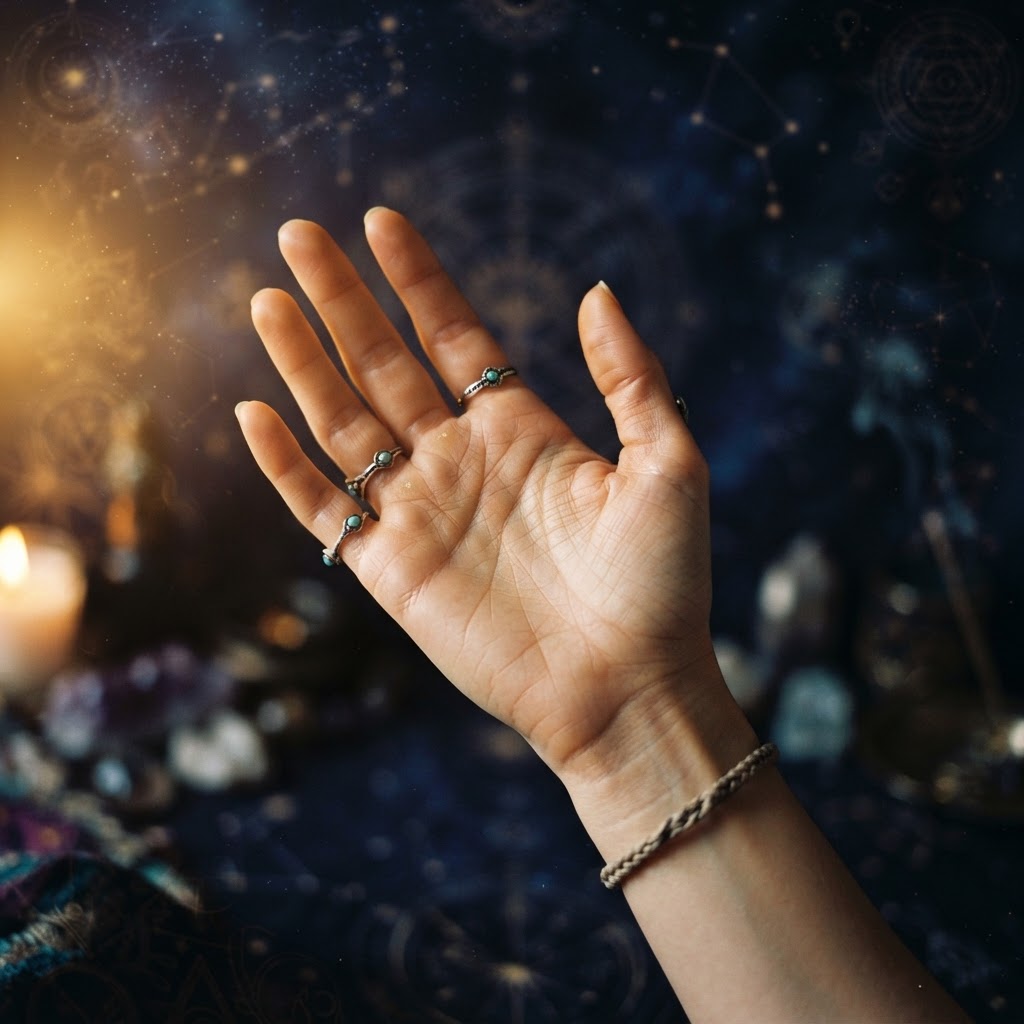
Secondary lines — mounts and hand shapes
Discover the role of secondary lines, mounts of the palm, and the shapes of hands, fingers, and thumbs.
Secondary Lines: Fate, Sun, Mercury, and Unions
Fate Line
The Fate Line usually rises towards the middle finger. It is associated with direction, responsibilities, and changes of course. Not all hands show this line clearly, and its absence does not mean a lack of purpose. Beginnings, interruptions, and encounters with other lines can suggest phases where personal decisions, relationships, or circumstances gain more prominence.
Sun Line
Also called the Apollo Line, it appears towards the ring finger and is traditionally related to creative expression, satisfaction, and recognition. A subtle line does not prevent accomplishment. When visible, it should be observed in conjunction with the Mount of Apollo, the fingers, and the rest of the palm, avoiding promises of fame or financial success.
Mercury Line
The Mercury Line can be linked to communication, exchange, and the ability to connect knowledge. As its shape varies greatly and it can be confused with minor marks, reading should be cautious. It is not used to conclude health conditions nor to replace professional evaluation.
Union Lines
Small lines on the side below the little finger are called, in some schools, union lines. They can be read as significant bonds, but they do not determine the number of marriages, the duration of relationships, or the identity of partners. Responsible use avoids turning subtle marks into rigid affective predictions.
Starting points and changes of direction
The origin of a secondary line modifies its traditional reading. A Fate Line starting near the Life Line may be associated with the gradual building of autonomy; when it emerges from the outer region of the palm, it may emphasize the influence of environments, the public, or relationships. Changes in direction show that the symbolic path is not linear. The encounter with the Head or Heart Line can highlight decisions, bonds, or values as points of reorganization, without determining an exact age or event.
When the line is short, multiple, or faint
Secondary lines vary more than the main ones. A short line may highlight only one phase; two close lines may suggest parallel activities or coexisting directions; an almost invisible line may simply not be a central axis of the hand. Absence does not represent inability. Responsible interpretation describes what is present and avoids filling gaps with assumptions. It is also important to check if the line appears on both hands and if it does not result from a crease, scar, or shadow.

Hand Mounts and Their Meanings
What are the mounts
The mounts are areas of volume on the palm, named in the palmistry tradition in reference to planets. We observe relief, firmness, and balance between areas, not just which region appears larger. Hand position, pressure, and light alter their appearance; therefore, the meaning should be presented as a visual hypothesis.
Venus, Moon, and Mars
The Mount of Venus, at the base of the thumb, is associated with affection, vitality, and engagement with life. The Mount of the Moon, on the lower outer edge, is linked to imagination, sensitivity, and the inner world. The areas of Mars are related to initiative, resilience, and how challenges are handled. None of them prove temperament or behavior.
Jupiter, Saturn, Apollo, and Mercury
Beneath the fingers are the mounts of Jupiter, Saturn, Apollo, and Mercury. They are related, respectively, to aspiration and leadership; depth and responsibility; creativity and expression; communication and exchange. A very prominent mount may indicate symbolic concentration in that field, but interpretation depends on the fingers, lines, and nearby signs.
Balance before intensity
A hand may present several similar mounts, suggesting a more balanced distribution, or a clear contrast between regions. The goal is not to classify mounts as good or bad, but rather to observe how different symbolic functions coexist. This synthesis avoids labels and produces a more coherent reading.
Relief, firmness, and position
A mount is not analyzed solely by appearing high. Firmness, extent, centralization, and relation to neighboring areas are observed. A mount can be wide and not very firm, concentrated and marked, or shifted towards another. These details alter the reading: concentration can reinforce a symbolic function, while shifting can indicate that two fields work together. A relaxed hand offers a more reliable reference, as muscle tension temporarily changes the relief.
Signs located on the mounts
Vertical lines, grids, crosses, and small triangles receive traditional interpretations when they appear clearly on a mount. A vertical line can reinforce the expression of that field; many crossed lines can indicate dispersion or complexity. No sign should be interpreted without confirming its clarity and location. When the same symbol touches a main line and a mount, the reading should explain the connection between area and function, rather than offering two separate meanings.

Hand, finger, and thumb shapes
The general shape
Some traditions group hands according to the proportion between palm and fingers and associate the groups with the elements Fire, Earth, Air, and Water. More elongated, square palms, long or short fingers form combinations. These groups function as interpretive shortcuts, not as rigid boxes or capacity evaluations.
Fingers and phalanges
Relative length, spacing, inclination, and finger joints add details. The index finger can be associated with assertion; the middle, with structure; the ring, with expression; the little, with communication. The phalanges are also observed as symbolic levels of idea, application, and materialization.
The role of the thumb
The thumb receives attention for its opening, length, and flexibility. A wide opening can be linked to autonomy and availability to experiment; a position closer to the palm, to selectivity and preservation. Flexibility varies naturally and should not be forced nor used to judge someone.
Responsible synthesis
A good analysis describes patterns: hand of a certain group, thumb with a certain opening, fingers that reinforce or balance the lines. When elements seem contradictory, it is not an error; it may indicate that the person expresses themselves in different ways depending on the context. The result should value nuances.
Proportions that modify elemental groups
Elemental groups become more useful when real proportions are observed. An elongated palm with also long fingers can reinforce qualities associated with Water; a square palm and long fingers approach Air; a long palm with short fingers is usually linked to Fire; a square palm and short fingers, to Earth. Many hands are mixed. In such cases, the report should name the predominant pattern and explain the secondary element that brings balance or contrast.
Spacing, inclination, and fingertips
Close fingers can be associated with selectivity and organization; more open spaces, with independence between functions. Inclinations show which finger seems to support another symbolically. Rounded, square, or pointed tips are also part of traditional classifications related to the way of perceiving and concretizing. These details do not measure ability or intelligence. They serve to enrich the synthesis when they coincide with lines, mounts, and the hand's way of opening.

The meaning you have just read is the basis for understanding what your hand reveals. Yet the exact message lives in the details only your palm holds. Is the line deep or shallow? Are there branches splitting in opposite directions? Is there any break, island or chain that alters the flow of energy? In palmistry, each of these small elements radically changes the interpretation, revealing anything from inherited family patterns to opportunities still forming in the silence of your hands.
If you are looking for an exact answer and don't want to be left wondering what your hand is asking of your practical life today, we can go deeper. Use 1 Mística Palm Credit for a Sophisticated Palmistry Analysis. Simply send a photo of your palm on our platform to receive a complete, serious diagnosis focused 100% on your current moment.
Keep exploring
Discover how lines, mounts, and shapes come together in your analysis.