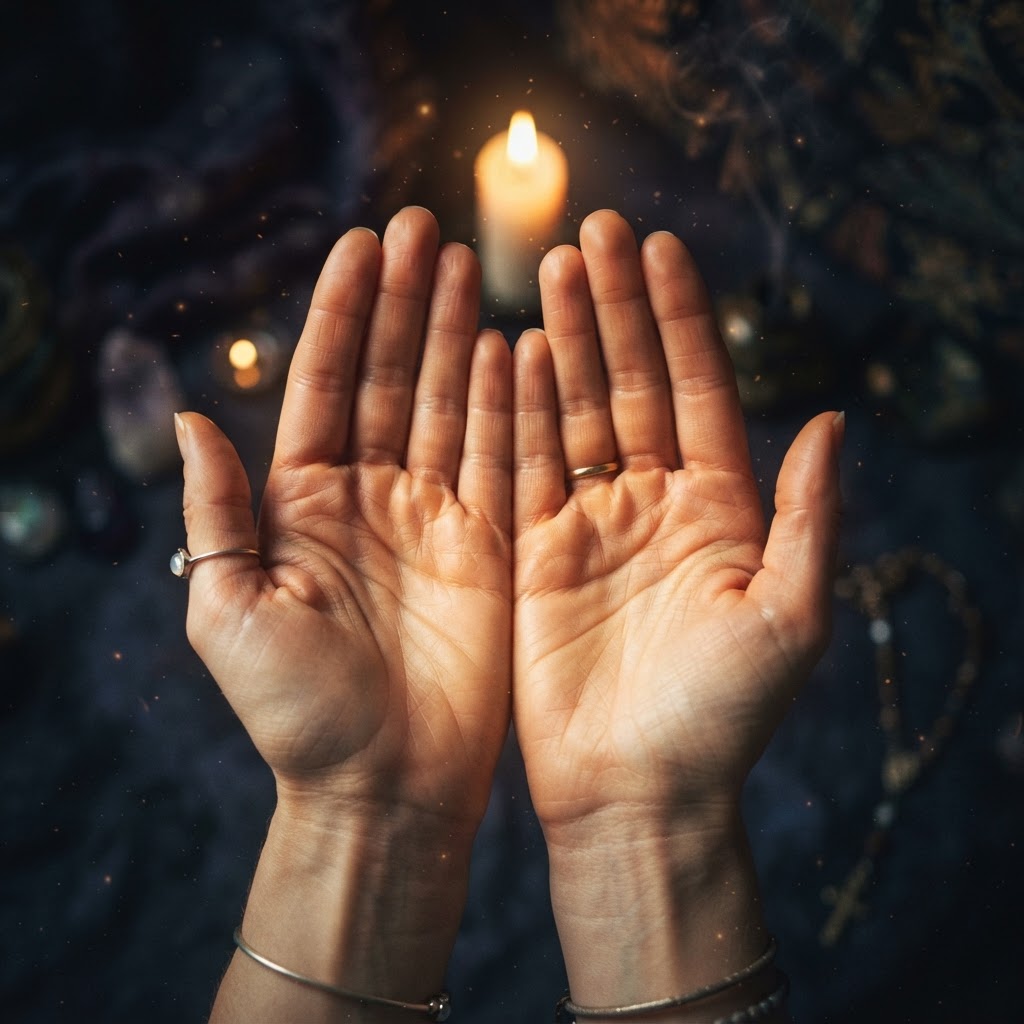
What is palmistry: major lines and the palm treatise
Understand how lines, mounts, fingers, proportions, chronology of destiny, and dermatoglyphs are gathered in a symbolic reading of the hands.
A guide to understanding the language of the hands
A tradition of symbolic reading
Palmistry is a tradition of hand observation present, through different methods, in various cultures. Instead of looking at only one line, the reading gathers the pattern of the palm, the texture, the mounts, the shape of the fingers, and the relationship between the two hands. At Mística Palm, this repertoire is treated as symbolic language: it offers questions and possibilities for reflection, not a sentence about the future.
The whole is worth more than a single sign
A long Heart Line, for example, does not by itself produce a reliable conclusion. Its direction, depth, proximity to other lines, and the overall balance of the palm modify the reading. The same care applies to crosses, islands, and forks. Temporary marks, scars, and shadows should not be automatically turned into permanent symbols.
Why compare the hands
Many schools associate the dominant hand with the current way of acting and the other with underlying tendencies. This distinction is not absolute, but the comparison helps to notice differences: a line may be more marked on one side, a mount may appear more developed, or the flexibility may change. The reader must inform which hand they use most frequently so that the analysis is organized.
A reading that follows changes
Hands change with age, work, movement, and experiences. For this reason, palmistry works better as an interpretive portrait of a moment than as an immutable prediction. The result may highlight themes of attention, contrasts, and potentials, always preserving the user's freedom to agree, question, and build their own meaning.
What is observed in the quality of the lines
Beyond the position, one observes whether the stroke is deep or delicate, continuous or fragmented, uniform or variable. A deep line is usually interpreted as a theme experienced with intensity and constancy; a thin line may indicate an expression that is more subtle or sensitive to the context. This does not establish superiority. Very marked lines can concentrate energy, while light strokes can show flexibility. Color, lighting, dryness, and manual activity also alter the appearance, so the analysis needs to separate skin characteristics from symbolic elements.
How an interpretation is built
The reading can follow an order: identify shape and texture, locate main lines, observe mounts and fingers, compare the hands, and only then examine smaller signs. Next, themes that appear more than once are sought. If autonomy is suggested by the thumb, by the separation between lines, and by certain branches, the interpretation gains coherence. If one element contradicts the others, it should appear as a nuance, not be erased to produce an artificially perfect answer.

Main lines: Life, Head, and Heart
Life Line
The Life Line contours the base of the thumb and is symbolically related to rhythm, vitality, and the way of living through changes. Its length does not indicate how many years someone will live. Depth, curve, continuity, and small branches help to formulate a reading about intensity, adaptation, and phases, without turning the hand into a diagnostic tool.
Head Line
The Head Line crosses the central region of the palm and is associated with reasoning, concentration, imagination, and decision-making. Straighter strokes are traditionally linked to objective approaches; curves may suggest greater involvement of imagination. These are general associations that need to be combined with the start, end, and interaction with other lines.
Heart Line
Located in the upper part of the palm, the Heart Line is linked to affective expression, expectations in relationships, and the way of processing feelings. Direction, branches, and termination under certain fingers alter the reading hypotheses. It does not reveal fidelity, guaranteed compatibility, or another person's secret feelings.
When lines meet
The richest part arises from relationships. A joint start between the Life and Head Lines can be read as a more cautious way of beginning; a wide separation may suggest autonomy. The space between the Head and Heart Lines helps observe how reason and emotion seem to coexist in the pattern. These readings are symbolic and only gain meaning when considered as a whole.
Start, course, and termination
Each line can be read as a journey. The start shows how the theme is organized; the central part, how it develops; and the termination, where it symbolically tends to go. On the Life Line, a wide arc or one close to the thumb changes the relationship with space and rhythm. On the Head Line, the final direction can reinforce objectivity, imagination, or a combination of both. On the Heart Line, the termination point and small branches help observe how affection and expectations seek expression.
Depth, breaks, and parallel lines
A break should not be announced as a tragic event. It can mark a change of phase, reorganization, or discontinuity in the way of living that theme. Parallel lines can be understood as reinforcement, support, or a complementary path. When a segment reappears after an interruption, the reading may speak of resumption. The meaning depends on overlap, distance, connecting lines, and differences between the two hands.
Ascending and descending branches
Branches that go up are traditionally related to mobilization, expansion, or an attempt to develop the subject represented by the line. Descending branches may indicate dispersion, wear, or the need for redirection. This opposition is just a reading principle. A branch needs to be placed within its course, compared to other signs, and explained without rigid predictions. Several fine branches may show diversity of interests, while few clear branches may highlight more focused directions.

The cartography of the skin and the chronology of destiny
Beyond the main lines
For a palmistry reading to be truly profound, it is necessary to observe the palm in its entirety. The physical structure of the hand—its reliefs, depressions, texture, and color—forms the terrain where symbolic destiny manifests. The muscular elevations at the base of each finger and along the sides act as reservoirs of vital energy.
The great Mount of Venus
The fleshy elevation at the base of the thumb, the Mount of Venus, is observed for its firmness and volume. A marked elevation is symbolically associated with reserves of strength and capacity for surrender; a flatter base may suggest a need for grounding and attention to personal boundaries. This reading should always be combined with the lines and other elements of the palm.
The chronology of destiny
One of the most complex aspects of palmistry is the marking of time within the lines. The major markings are not merely indicators of static personality, but chronological records that map life phases. The base of the lines near the wrist is associated with origin and roots; the center of the palm marks major rites of passage and restructuring.
Minor signs and karmic marks
Formations such as stars, islands, and small oval openings in continuous lines are interpreted as symbolic catalysts. A star formation can indicate an outburst of energy or a turning point; an oval opening may suggest a period of dispersion or a detour. These signs only gain meaning within the context of the palm and should be presented as hypotheses.
Dermatoglyphic patterns
Fingerprints as an original blueprint
The microscopic ridges that form the prints on the fingertips and areas of the palm carry a pattern formed in the womb that remains unchanged throughout life. Unlike palm lines, which can change over time, papillary patterns are considered the non-negotiable psychic foundation of the being.
Arches, loops, and whorls
Identifying whether a fingertip presents an arch, loop, or whorl pattern is an advanced part of a palmistry reading. A closed and complex whorl, for example, may be associated with a highly individualistic soul, whose journey requires the development of internal authority without depending on external validation.
Combination and synthesis
The presence of different patterns on distinct fingers creates a unique combination. A responsible reading does not transform each pattern into an isolated prediction, but observes how the set reveals basic psychic tendencies. These elements should complement, rather than replace, the analysis of the lines and mounts.

The meaning you have just read is the basis for understanding what your hand reveals. Yet the exact message lives in the details only your palm holds. Is the line deep or shallow? Are there branches splitting in opposite directions? Is there any break, island or chain that alters the flow of energy? In palmistry, each of these small elements radically changes the interpretation, revealing anything from inherited family patterns to opportunities still forming in the silence of your hands.
If you are looking for an exact answer and don't want to be left wondering what your hand is asking of your practical life today, we can go deeper. Use 1 Mística Palm Credit for a Sophisticated Palmistry Analysis. Simply send a photo of your palm on our platform to receive a complete, serious diagnosis focused 100% on your current moment.
Keep exploring
Discover a complete reading of your hands.