Birth Chart: The Big Three, Planets, and Houses
Explore the astrological wheel, the Sun/Moon/Rising trio, personal and social planets, and the twelve houses.
What Is a Birth Chart
A Symbolic Portrait of the Sky
A birth chart represents the positions of the Sun, Moon, planets, and other points for a person’s date, time, and place of birth. The wheel contains 360 degrees, twelve signs, and twelve houses. It is not a generic horoscope: each position gains meaning through its combination with the others.
Calculation Comes Before Interpretation
Positions must be obtained using ephemerides and reliable astronomical rules. Interpretation can organize the language and explain patterns, but it should not invent degrees, houses, or aspects. The result should record the date, location, time zone, and house system.
The Four Layers
Planets represent functions; signs show how those functions are expressed; houses indicate areas of experience; aspects reveal angular relationships. “Venus in Leo in the 7th House opposite Saturn,” for example, requires an integrated reading of all four layers.
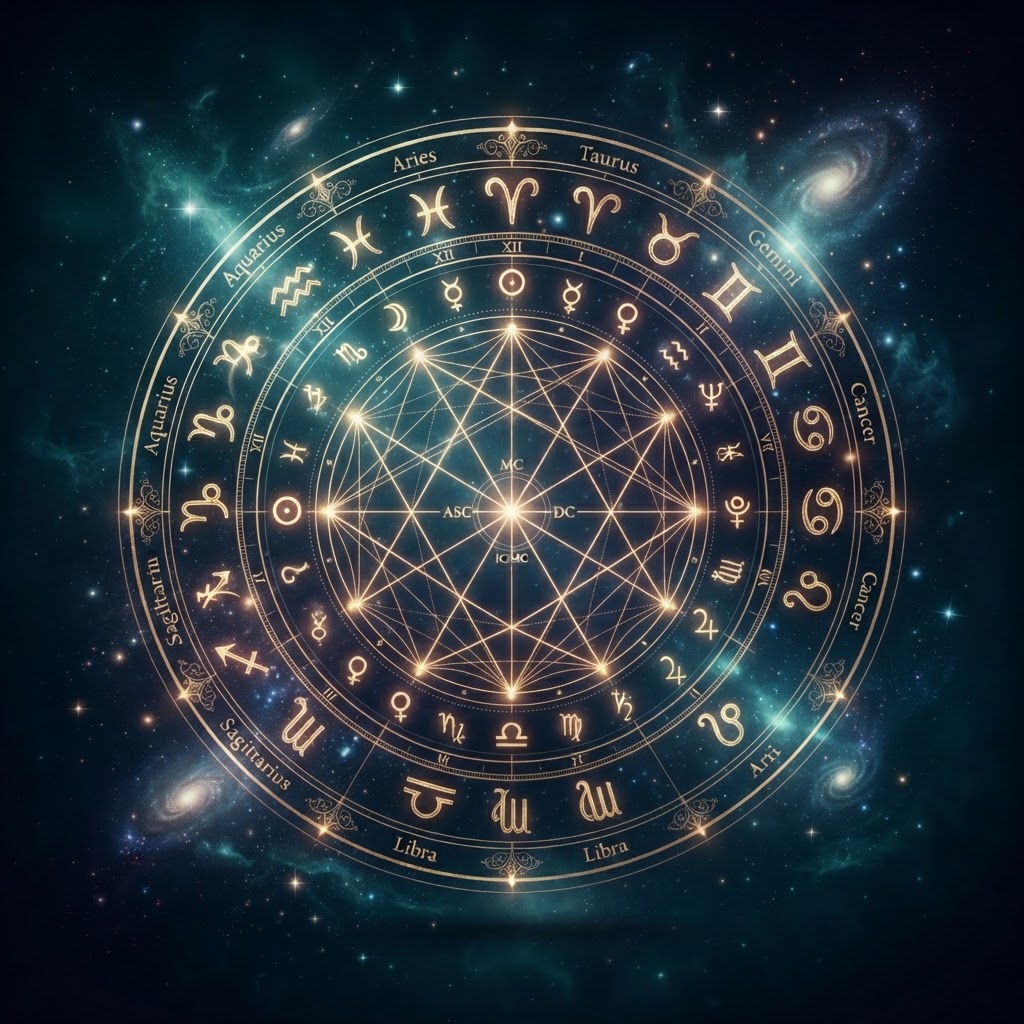
The Wheel and Its Lines
In the chart, planetary symbols appear around the wheel, while internal lines connect aspects. Colors can distinguish flowing and tense relationships, accompanied by an accessible legend. The chart should allow users to select a point and open its explanation.
Sign, House, and Degree
Saying that a planet is in a particular sign is only the beginning. The degree locates the position precisely and makes it possible to calculate aspects; the house shows the area where it manifests. Planets close to a cusp may require a clearly defined rule within the system. The report should present the complete position, avoiding interpretations that ignore half the data. A planet in a similar sign can act differently in different houses and aspects.
Angles and Principal Axes
The Ascendant and Descendant form the axis of identity and encounter; the Midheaven and Imum Coeli organize public direction and private foundations. Planets close to these angles often gain prominence. The wheel should clearly mark the four points and allow users to open explanations. When the birth time is uncertain, the site must warn that angles and houses may change, while retaining only the elements that can be calculated reliably.

Sun, Moon, and Ascendant: The Big Three
Sun
The Sun is associated with conscious identity, vitality, and developmental direction. The Sun sign shows a symbolic way of asserting one’s presence, but it does not sum up the personality. The house and aspects reveal where and how this function gains prominence.
Moon
The Moon relates to emotional needs, habits, memory, and the search for security. Its sign describes an emotional language; the house shows where that need appears; aspects indicate how it interacts with other functions.
Ascendant
The Ascendant is the sign that was rising on the horizon at the time of birth. It is associated with how we begin, perceive our surroundings, and present ourselves. Because it changes approximately every two hours, it depends on a precise birth time and location.
Synthesizing the Big Three
Harmonious combinations can reinforce a style; differences between elements can reveal needs that alternate. A Fire Sun, Water Moon, and Earth Ascendant are not a contradiction: they indicate distinct layers of intention, emotion, and approach.
Element, Modality, and Rulership
Each component of the Big Three belongs to an element and modality. The element describes a symbolic way of processing experience; the modality shows how one initiates, sustains, or adapts. The planet ruling the Ascendant adds another layer: its position by sign, house, and aspect helps explain how the Ascendant finds direction in the chart. This integration goes beyond three isolated descriptions.
When the Big Three Reinforce or Contrast
If the Sun, Moon, and Ascendant share an element, that mode of expression may appear with ease and intensity. If they belong to different elements, the user may alternate between needs, presentation, and conscious aims. Contrast does not mean incoherence. The synthesis should show in which situations each layer tends to appear and which resources can help create balance.

Personal, Social, and Generational Planets
Personal Planets
The Sun and Moon, together with Mercury, Venus, and Mars, describe functions close to everyday experience: identity, emotion, thought, values, bonds, desire, and initiative. Interpretation should avoid reducing Venus solely to romance or Mars solely to conflict.
Social Planets
Jupiter is associated with expansion, confidence, and meaning; Saturn with limits, structure, and responsibility. They are called social planets because they connect individual development with rules, institutions, and worldviews.
Generational Planets
Uranus, Neptune, and Pluto remain in each sign for long periods and mark generations. To personalize their interpretation, it is especially important to observe the house, aspects, and proximity to the chart’s angles.
No Planet Is the Villain
Saturn is not punishment, Pluto does not announce disaster, and Mars does not determine aggressiveness. Each symbol can appear in constructive or challenging ways. A mature reading shows resources, excesses, and paths toward integration.
Dignities and Symbolic Condition
Some traditions consider domicile, exaltation, detriment, and fall when assessing how a planet expresses its function in a sign. These categories do not mean that a planet is good or bad. A position considered challenging can develop its own solutions, especially when it receives supportive aspects. The site should present dignity as a technical detail and never let it replace the reading of the house, degree, and aspects.
Retrograde Planets
Retrogradation is an apparent motion observed from Earth. In natal interpretation, it is often associated with more inward processes, revisions, or less conventional ways of expressing a planet’s function. It does not indicate inevitable delay or a flaw. Natal Mercury retrograde, for example, should be analyzed within the complete chart, without repeating generic predictions about communication problems.

The Twelve Astrological Houses
Houses 1 to 3
The 1st House relates to presence and beginnings; the 2nd to resources, values, and support; the 3rd to communication, learning, and the immediate environment. Planets in these areas highlight how their functions participate in these themes.
Houses 4 to 6
The 4th House involves roots, home, and emotional foundations; the 5th, creative expression, pleasure, and personal projects; the 6th, routine, service, and everyday organization. No house should be reduced to a single event.
Houses 7 to 9
The 7th House concerns encounters and partnerships; the 8th, deep exchanges, shared resources, and transformation; the 9th, broad studies, beliefs, travel, and the search for meaning. The reading must consider the sign on the cusp and its ruling planet.
Houses 10 to 12
The 10th House relates to public direction and achievement; the 11th to groups, networks, and collective projects; the 12th to retreat, imagination, and less conscious content. Without a reliable birth time, houses and angles should be omitted or presented as uncertain.
Cusp, Ruler, and Planets Present
Reading a house begins with the sign on its cusp. Next, locate the planet that rules that sign and observe where it is placed. Planets within the house add functions that are directly involved. This sequence creates a network: an empty house remains active through its sign and ruler. Therefore, the absence of planets does not mean an absence of events or importance.
House axes
Houses also function in pairs: 1 and 7 deal with identity and relationships; 2 and 8, personal and shared resources; 3 and 9, immediate knowledge and broad vision; 4 and 10, private foundation and public direction; 5 and 11, individual expression and collective participation; 6 and 12, routine and withdrawal. Reading the axes avoids fragmented interpretations and shows where balance can be built.
The meaning you have just read is the basis for understanding what the stars reveal about you. Yet the exact message lives in the details only your chart holds. Which house is the planet placed in? Are there tense or flowing aspects with other planets? Does the exact degree of your ascendant shift the interpretation to another sign? Is any retrograde planet modifying the expression of your energy? In astrology, each of these small elements radically changes the interpretation, revealing anything from karmic challenges to potentials that only manifest at the right time.
If you are looking for an exact answer and don't want to be left wondering what the stars are asking of your practical life today, we can go deeper. Use 1 Mística Palm Credit for a Sophisticated Astrology Analysis. Simply enter your birth details on our platform to receive a complete, serious diagnosis focused 100% on your current moment.
Keep exploring
Get to know your complete astral chart with an interactive design.