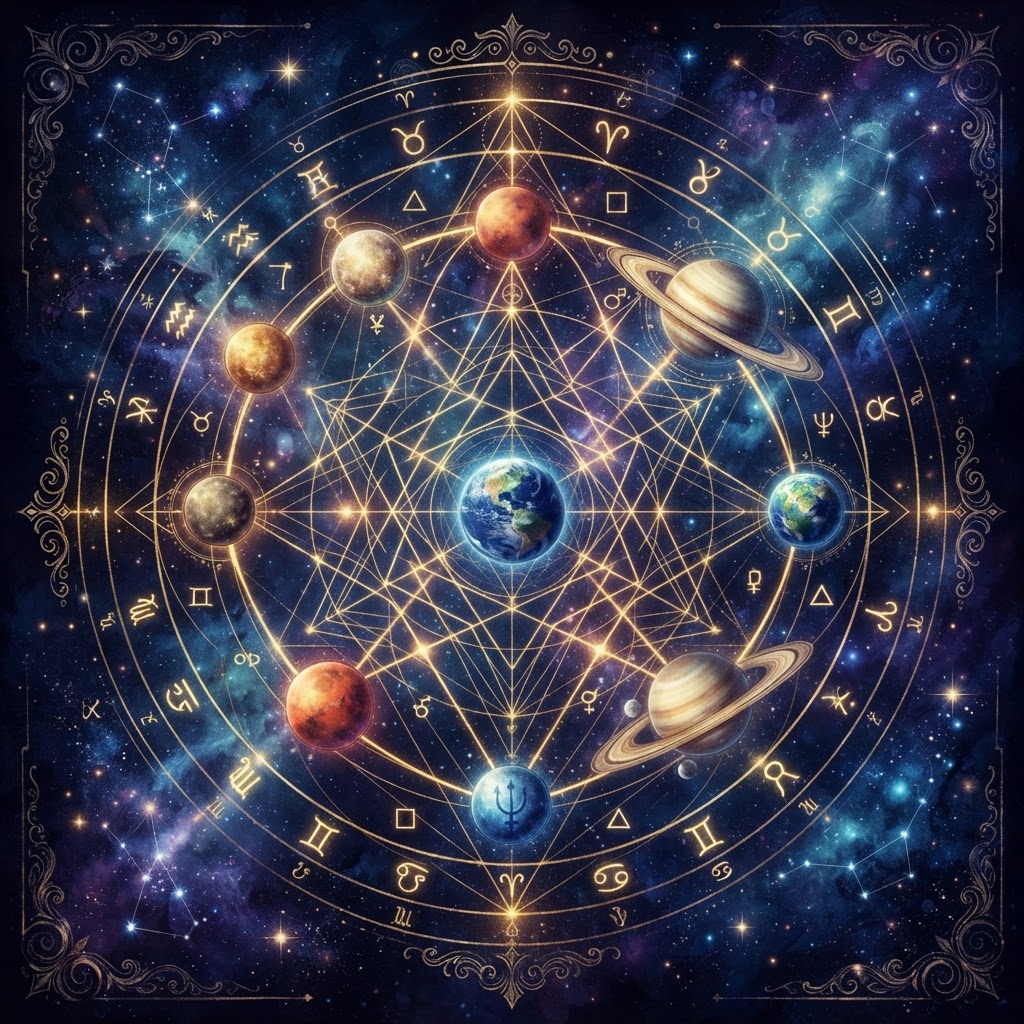
Aspects, transits, and karmic astrology
Understand the map's aspects, transits, Lunar Nodes, Chiron, Saturn Return, and Lilith.
Astrological aspects: the lines of the chart
What is an aspect
An aspect is the angular distance between two points. The software compares the degrees and applies a margin called an orb. The closer to the exact angle, the greater the interpretative emphasis usually is, although the planet and type of aspect also matter.
Conjunction and opposition
In a conjunction, two functions unite and can act as a single block. In an opposition, they occupy opposite poles and require an awareness of balance. Opposition does not mean failure; it can create perspective and movement when both sides find space.
Square, trine, and sextile
Squares highlight friction and the need for action. Trines show fluidity and natural resources, which can also become underutilized. Sextiles suggest opportunities that grow with participation. No aspect is entirely good or bad.
How to read the design
Internal lines should use consistent colors and a legend. By tapping on a connection, the user sees planets, angle, orb, and interpretation. The synthesis should prioritize a few strong aspects instead of an extensive and repetitive list.
Orbs and priority
The orb is the difference between the actual aspect and the exact angle. A two-degree conjunction usually receives more weight than an eight-degree one, although luminaries and different schools accept their own margins. The system must declare its orbs and order aspects by relevance. This prevents the report from treating dozens of connections as equally important and helps the user understand why some lines appear stronger in the design.
Configurations with three or more points
When multiple aspects form a repeated design, configurations like a T-square, grand trine, or Yod emerge. They need to be explained as patterns of integration between functions, not as extraordinary destinies. A grand trine may indicate a fluid resource that requires conscious use; a T-square, tension that mobilizes development. Before naming a configuration, the calculation must confirm the degrees and orbs of all involved points.

Transits and daily astrological message
Natal chart and current sky
Transits compare current positions with birth points. The sun sign can guide a general message, but a truly personalized experience considers the Moon, Ascendant, houses, and closer aspects.
What to prioritize
The daily message should highlight two or three relevant factors, show the date, and use the user's time zone. Fast movements can speak to the day's mood; slow ones describe longer processes. It is not useful to repeat every planet daily.
Responsible language
Instead of 'something bad will happen,' the text can say 'the aspect calls for attention to haste in conversations.' The goal is to offer focus, questions, and possibilities for action, never to provoke fear or promise specific events.
Credits and reveal
The profile can show the sun, moon, and Ascendant signs for free, along with a brief message. Credits reveal full interpretations of planets, houses, aspects, cycles, and detailed design. What is free versus paid should be clear before purchase.
Fast and slow transits
The Moon, Mercury, Venus, and Mars produce faster changes and help describe the daily climate. Jupiter, Saturn, and generational planets remain in aspect longer and represent processes. A daily message can combine a fast factor with a background process, making the validity period clear. This avoids repeating as news something that will be active for months.
Practical application without fixed predictions
The message can be organized into the day's focus, points of attention, and a reflection question. Instead of guaranteeing a result, it offers alternatives: reviewing a conversation, setting aside time, organizing priorities, or observing reactions. The user must understand which transit supports the guidance and be able to open the technical explanation. This transparency differentiates real personalization from generic phrases associated only with the sun sign.

The Lunar Nodes: purpose and stagnation
The axis of the Nodes
Beyond the trinity of Sun, Moon, and Ascendant, the axis of the Lunar Nodes is central to understanding the symbolic destiny in a chart. These are not planets, but celestial mathematical points where the Moon's orbit crosses the ecliptic. Each node represents a distinct direction.
South Node: comfort and stagnation
The South Node (Dragon's Tail) represents talents, instincts, and accumulated baggage that the soul has already mastered. It is the territory of autopilot: familiar and comfortable, but without space for new evolution. Remaining exclusively in this energy can result in stagnation and existential emptiness.
North Node: challenge and purpose
The North Node (Dragon's Head) represents the unknown territory, the attributes that the individual fears developing because they feel inadequate or inexperienced. Symbolically, it is the purpose of this incarnation. The journey consists of leaving the safety zone of the South Node to embrace the challenges of the North Node.
How to interpret the axis
The South Node should not be abandoned as if it were a flaw; it is the foundation from which one starts. The North Node is also not an absolute obligation, but a symbolic direction of development. The sign and house of each node contextualize where these themes appear in the user's experience.

Chiron, Saturn Return, and Lilith
Chiron: the wound and the gift
The asteroid Chiron orbits between Saturn and Uranus. In the astral chart, the house and sign where it rests indicate the so-called sacred wound — a theme of deep vulnerability, often associated with rejection, abandonment, or a feeling of inadequacy that resists definitive resolutions.
The alchemy of the wound
The great paradox of Chiron is that this wound was not placed in the chart to be eliminated, but to be accepted with compassion. When the individual stops trying to be invulnerable in that specific area, the pain itself becomes an instrument of empathy. Chiron's position can indicate where the person has the potential for deep acceptance and understanding.
The Saturn Return
Saturn completes its first lap around the zodiac around ages 28 to 30, returning to the exact point of birth. This transit is associated with the end of a formative cycle and the need to take responsibility for one's own life structure. Relationships, careers, and habits built on fragile foundations tend to be tested during this period.
Lilith (The Black Moon)
Lilith represents the lunar apogee—the point in the Moon's orbit farthest from Earth. In the birth chart, it points to primal rebellion, aspects of the psyche that resist submission, and contents often repressed due to fear of collective rejection. Studying its position can invite an integration of energies that have been silenced or demonized.
The meaning you have just read is the basis for understanding what the stars reveal about you. Yet the exact message lives in the details only your chart holds. Which house is the planet placed in? Are there tense or flowing aspects with other planets? Does the exact degree of your ascendant shift the interpretation to another sign? Is any retrograde planet modifying the expression of your energy? In astrology, each of these small elements radically changes the interpretation, revealing anything from karmic challenges to potentials that only manifest at the right time.
If you are looking for an exact answer and don't want to be left wondering what the stars are asking of your practical life today, we can go deeper. Use 1 Mística Palm Credit for a Sophisticated Astrology Analysis. Simply enter your birth details on our platform to receive a complete, serious diagnosis focused 100% on your current moment.
Keep exploring
Discover what connects each point of your astral wheel.